
If you have fallen ill and need to take time off work or university in Ireland, obtaining an official medical certificate is often a necessary first step. Under Irish employment law, a medical certificate acts as formal proof that you were examined by an Irish Medical Council (IMC) registered doctor and deemed unfit for duties.
Whether you are navigating the rules for Statutory Sick Pay (SSP), managing college absence guidelines, or wondering how to get a medical certificate online, this guide explains the legal requirements, valid formats, and practical steps you need to know.
What Is a Medical Certificate?
A medical certificate (commonly referred to as a sick cert, sick note, or doctor’s note) is an official document issued by a registered medical practitioner. It confirms that a patient is unfit to carry out their normal work, school, or university duties due to acute illness, injury, or a temporary medical condition.
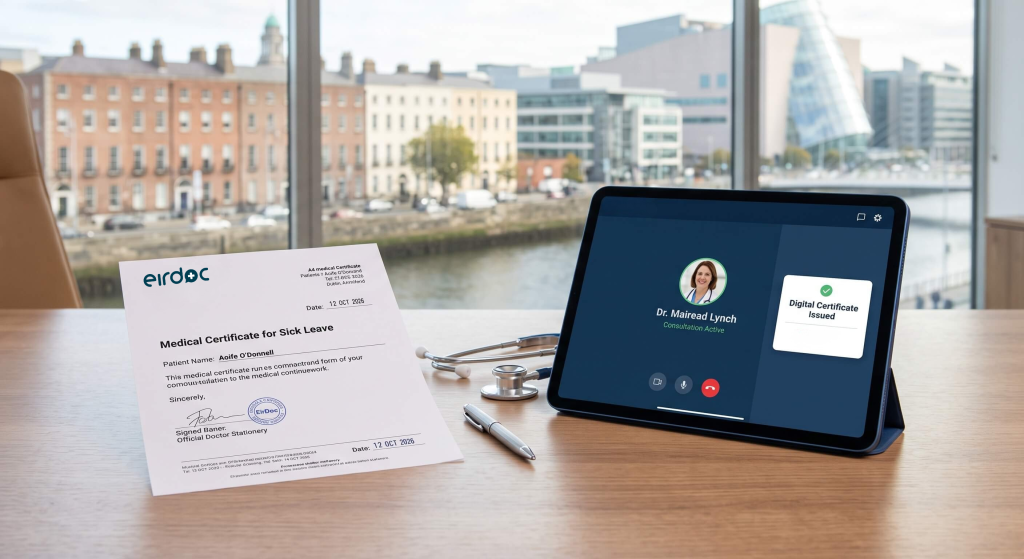
In Ireland, a standard medical certificate for your employer includes:
The patient’s full name.
The date of the medical assessment.
The expected duration of absence (start date and estimated return date).
The doctor’s professional details, registration number with the Irish Medical Council (IMC), and official signature.
Note on Medical Confidentiality:
Your GP is not required to reveal your specific medical diagnosis on a general workplace certificate. Statements indicating that you are unfit for work due to "medical reasons" or "illness" satisfy Irish workplace regulations and protect your health privacy.
Medical Certificate for Sick Leave: Statutory Rules in Ireland
Under the Sick Leave Act 2022, eligible employees in Ireland are legally entitled to paid statutory sick leave.
To access Statutory Sick Pay (SSP) from your employer:
Day One Certification: You must provide a valid medical certificate for sick leave covering your absence from the very first day. While company handbooks may allow informal self-certification for non-paid internal tracking, statutory sick pay requires doctor certification.
Employment Duration: You must have completed at least 13 continuous weeks of service with your employer.
Statutory Coverage: Eligible employees receive statutory sick pay for up to 5 days per calendar year, paid at 70% of regular daily earnings up to a legal maximum of €110 per day.
| Leave Type | Coverage Period | Medical Documentation Required | Payer |
| Statutory Sick Leave | Up to 5 working days per calendar year | Standard medical certificate from Day 1 | Employer |
| Illness Benefit | Absences extending beyond 5 statutory days | DSP Certificate of Incapacity for Work (eCert) | Department of Social Protection (DSP) |
| Company Sick Schemes | Defined by employment contract | Standard doctor’s certificate | Employer |
Standard Medical Certificate vs. Primary Medical Certificate
Searchers in Ireland frequently confuse general sick notes with a primary medical certificate. These are two entirely different legal and medical documents.
Standard Medical Certificate: A routine clinical document issued by a GP for short-term illness, absence management, university extenuating circumstances, or statutory sick pay.
Primary Medical Certificate (PMC): A specific, state-administered statutory certificate issued through the Health Service Executive (HSE). A PMC certifies severe, permanent physical disability to access specific schemes, such as the Disabled Drivers and Disabled Passengers Scheme for motor vehicle tax relief. A routine GP cannot issue a Primary Medical Certificate during a regular consultation; it requires a formal HSE Senior Area Medical Officer assessment.
Can You Get a Medical Certificate Online in Ireland?
Yes. An Irish-registered GP can assess your symptoms and issue a medical certificate online where it is clinically safe and appropriate.
Telehealth services across Ireland allow patients experiencing short-term illnesses, seasonal infections, digestive bugs, or minor injuries to consult a doctor remotely via secure digital platforms without waiting days for an in-person GP appointment.
How the Online Consultation Process Works
Complete a Clinical Questionnaire: Detail your current symptoms, medical history, workplace requirements, and the dates of your illness.
Doctor Assessment: An IMC-registered doctor reviews your condition. In many cases, a video or phone consultation is conducted to assess whether remote certification is suitable.
Receipt of Digital Certificate: If approved, a secure, signed digital certificate in PDF format is sent directly to your email for submission to your employer or educational institution.
Situations Suitable for an Online Medical Certificate
Mild respiratory infections, colds, and flu
Acute gastroenteritis and stomach bugs
Work-related stress or temporary burnout assessments
Non-urgent muscular strains or joint sprains
Routine follow-up extensions for existing conditions where in-person examination is not required
When an In-Person Examination or Emergency Care Is Required
Online doctors cannot safely certify conditions requiring urgent physical examination or immediate emergency intervention. You should attend an in-person clinic, emergency department, or dial 999/112 if you experience:
Severe or sudden chest pain or shortness of breath
Signs of stroke (face drooping, arm weakness, speech slurring)
Severe, unexplained abdominal pain
Significant head injuries or acute neurological deficits
Why Use Eirdoc Online Doctor for Your Sick Certificate?
When you are unwell, travelling to a clinic and sitting in a waiting room can delay recovery. Eirdoc Online Doctor provides convenient, rapid access to IMC-registered Irish GPs.
Irish Medical Council Registered GPs: Every certificate is reviewed and signed by a qualified doctor licenced to practice in Ireland.
Compliant with Workplace Legislation: Eirdoc medical certificates meet Irish statutory employer standards under the Sick Leave Act.
Fast Digital Delivery: Receive your PDF certificate securely without unnecessary clinic queues.
Integrated Care: If your condition also requires medication, doctors can send prescriptions directly to your local pharmacy via the secure HSE Healthmail network.
-
Can my Irish employer reject an online medical certificate?
Employers in Ireland are required to accept medical certificates issued by a doctor registered with the Irish Medical Council. As long as the online service uses IMC-registered practitioners and the certificate contains the doctor's registration details, it carries the same legal validity as a note from an in-person clinic.
-
Does a medical certificate need to show my diagnosis?
No. Irish employment guidelines and medical privacy laws respect patient confidentiality. A valid certificate only needs to state that you have been examined and are unfit to attend work due to illness or injury.
-
Can an online GP backdate a medical certificate?
Medical practitioners are bound by ethical regulations set by the Irish Medical Council. Doctors cannot backdate a medical certificate for days prior to your initial medical assessment unless clinical records verify you were under direct medical care during that period. You should always request a consultation on the first day you miss work.
-
How do I transition from Statutory Sick Pay to Illness Benefit?
If your illness lasts longer than 5 working days, you may be eligible for Illness Benefit from the Department of Social Protection. Your GP will need to submit a digital Certificate of Incapacity for Work (eCert) directly to the Department, and you will apply through MyWelfare.ie.
-
Can students use an online medical certificate for college exam deferrals?
Yes. Most Irish universities and third-level institutions (including Trinity College Dublin, UCD, UCC, and University of Galway) accept medical certificates from registered medical practitioners for extenuating circumstances and exam deferrals, provided the certificate covers the specific examination dates.