

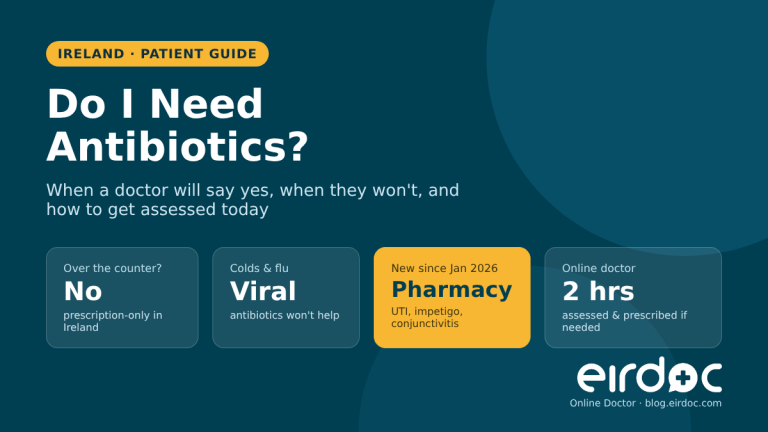
If you have a cold, sore throat, cough or chest infection and want antibiotics, here is the short version: in Ireland antibiotics are prescription-only, most of these infections are viral and antibiotics will not help, and since January 2026 a pharmacist can now prescribe for a few specific infections without a GP visit. This guide explains when a doctor will and won’t prescribe antibiotics, how to get them if you do need them, what the new pharmacy service covers, and when an infection needs urgent care.
Looking for the HSE prescribing guidelines for clinicians? They are at antibioticprescribing.ie. This page is written for patients.
Can you get antibiotics over the counter in Ireland?
No. Every antibiotic in Ireland is a prescription-only medicine. A pharmacy cannot sell one without a prescription from a doctor, dentist, nurse prescriber or — since 2026 — a pharmacist prescribing under the Common Conditions Service for a short list of conditions. Buying antibiotics online without a prescription is illegal, and the products are frequently counterfeit.
You can get a prescription three ways:
| Route | Covers | Typical cost | Speed |
|---|---|---|---|
| Your GP | Any infection | €50–€70 private; free with a medical card | Next available appointment |
| Pharmacist (Common Conditions Service) | 8 listed conditions only — see below | Consultation fee set by each pharmacy (ask before you start), plus the medicine | Walk in, same day |
| Online doctor (Eirdoc) | Most infections that can be assessed by video | €39 | Same day, usually within 2 hours; prescription sent to your pharmacy |
Which infections can a pharmacist now treat?
The Common Conditions Service launched on 19 January 2026 and is offered in about 94% of Irish pharmacies. A trained pharmacist can assess you in a private consultation room and prescribe, where appropriate, for:
- Uncomplicated urinary tract infection (cystitis) in non-pregnant adult women, within the HSE protocol’s age limits
- Impetigo
- Infective conjunctivitis
- Cold sores
- Shingles
- Oral thrush
- Vaginal thrush
- Allergic rhinitis (hay fever) and allergic conjunctivitis
Only three of these usually involve an antibiotic — UTI, impetigo and bacterial conjunctivitis. The pharmacist follows an HSE protocol and will refer you to a GP if you fall outside it (for example a UTI in a man, in pregnancy, or with fever and back pain). Tax relief applies to the consultation fee in the same way as a GP visit.
When will a doctor prescribe antibiotics?
Only when the infection is probably bacterial and antibiotics are likely to change the outcome. The doctor weighs your symptoms, how long you have had them, your examination or video assessment, and your risk factors (age, pregnancy, diabetes, immune problems, lung or heart disease).
| Infection | Usually viral or bacterial? | Antibiotics? |
|---|---|---|
| Common cold, blocked nose | Viral | No |
| Flu, COVID-19 | Viral | No (antivirals in some high-risk cases) |
| Sore throat | Mostly viral; about 1 in 5 are bacterial (strep) | Only if a strep score or swab points to bacteria |
| Acute cough / bronchitis | Viral in most healthy adults | Usually no; yes if pneumonia is suspected |
| Sinusitis | Viral for the first 10 days | Only if severe or lasting more than 10 days |
| Ear infection (children) | Mixed; most settle in 2–3 days | Often “wait and see”; yes if under 2 with both ears, or severe |
| Chest infection with fever, breathlessness | Can be bacterial | Yes, after assessment |
| UTI / cystitis | Bacterial | Usually yes |
| Skin infection — cellulitis, infected wound, impetigo | Bacterial | Yes |
| Tooth abscess | Bacterial | Short course, plus a dentist |
The rule Irish doctors work to, set by the HSE’s antimicrobial stewardship programme, is “the right antibiotic, at the right dose, for the shortest effective time — and none at all when it won’t help.”
Why your doctor said no
Four reasons, and none of them is that the doctor is being difficult:
- Antibiotics do nothing against viruses. Colds, flu, most sore throats and most coughs are viral. An antibiotic will not shorten them by a single day.
- Side effects are real. Diarrhoea, thrush, rashes and, less often, serious allergic reactions. For a viral illness that is all risk and no benefit.
- Resistance. Every unnecessary course makes the bacteria in your body — and in the community — harder to treat next time. Ireland has among the higher antibiotic use rates in northern Europe, and resistant infections are already a daily problem in Irish hospitals.
- Delayed prescribing works. For some infections the doctor may give you a prescription to use only if you are not better in 2–3 days. Most people never need to fill it.
If you were refused and you get worse, go back — a second assessment is normal practice, not a nuisance.
How to get antibiotics in Ireland if you do need them
- Decide the route. UTI (women), impetigo, conjunctivitis → pharmacy. Anything else, or if you are not sure → GP or online doctor.
- Book an assessment. For an online consultation, book with Eirdoc and describe your symptoms, when they started and any medical conditions or allergies.
- Be examined or assessed. The doctor may ask you to show your throat, a rash or a wound on camera, take your temperature, or describe your urine symptoms. If a physical examination or a test is essential, they will tell you to be seen in person.
- Get the prescription. If an antibiotic is appropriate it is sent electronically (via Healthmail) to the pharmacy you choose, usually the same day. If it is not, you will get advice on what will actually help and when to seek further care.
- Collect and complete the course as prescribed. Do not stop early because you feel better, and do not keep leftovers for next time.
Can an online doctor prescribe antibiotics in Ireland?
Yes. Irish Medical Council registered doctors can prescribe antibiotics after a video or phone consultation, following the same HSE guidance as a GP, and the prescription goes straight to your pharmacy. Online doctors are suited to UTIs, skin infections you can show on camera, tonsillitis, sinus and ear infections, dental infections while you wait for a dentist, and travellers’ diarrhoea. They will not prescribe without an assessment, and they will refer you if you need to be examined in person or seen urgently.
When an infection needs urgent care
Go to an emergency department or call 112/999 if you have:
- Difficulty breathing, chest pain or blue lips
- A rash that does not fade when a glass is pressed on it
- Confusion, severe drowsiness or a seizure
- A very high fever with shivering, fast heartbeat and feeling very unwell (possible sepsis)
- Severe pain or swelling spreading quickly from a wound
Contact a GP or out-of-hours service the same day if you have a fever over 38°C lasting more than 3 days, blood in your urine or sputum, a UTI with back pain or vomiting, or symptoms that are getting worse rather than better after a week.
Antibiotic safety at home
- Take the full course exactly as prescribed, spaced evenly through the day.
- Check whether to take it with food and whether alcohol is a problem for that particular medicine.
- Never share antibiotics or use someone else’s, even for the “same” infection.
- Return unused antibiotics to a pharmacy (the DUMP scheme) rather than binning them.
- If you get a widespread rash, swelling of the face or lips, or trouble breathing after a dose, stop and seek urgent help.
Frequently asked questions
Can you get antibiotics over the counter in Ireland? No. All antibiotics are prescription-only. Since January 2026 a pharmacist can prescribe for uncomplicated UTI in women, impetigo and conjunctivitis under the Common Conditions Service, but you still need that assessment.
Can online doctors prescribe antibiotics? Yes. An Irish Medical Council registered doctor can prescribe after a video consultation and send the prescription electronically to your pharmacy.
Why did my doctor not prescribe antibiotics for my cold or flu? Because colds and flu are viral. Antibiotics do not work on viruses and would only expose you to side effects and increase resistance.
How long do antibiotics take to work? Most people feel better within 48–72 hours of starting. If you are no better after 3 days, or worse at any point, contact the prescriber.
Do I need a prescription for antibiotics in Ireland? Yes, always. A GP, online doctor, dentist, nurse prescriber or — for listed conditions — a pharmacist can issue one.
Where are the HSE antibiotic prescribing guidelines? The clinician guidelines are published by the HSE at antibioticprescribing.ie. This article is a patient guide to how those rules affect you.
How much does an antibiotic prescription cost? The consultation is the main cost: a private GP visit is usually €50–€70, a pharmacy consultation is priced by each pharmacy, an online consultation €39. The medicine itself is typically €5–€20, or covered by a medical card or the Drugs Payment Scheme.
Not sure if you need antibiotics?
An Eirdoc doctor can assess your symptoms by video today, prescribe if an antibiotic is the right treatment, and tell you what will actually help if it isn’t. Book an online consultation.
Sources
- Antibiotic prescribing guidelines — HSE / antibioticprescribing.ie
- Common Conditions Service — Pharmaceutical Society of Ireland
- Common Conditions Service FAQ — HSE (updated March 2026)
- Minister signs legislation enabling pharmacists to prescribe — gov.ie
This article is for general information only and is not a substitute for individual medical advice. If you are unwell, speak to a doctor or pharmacist.
-
2) Why did my doctor not prescribe antibiotics?
It is important to note that your doctor will not prescribe antibiotics to you unless it is determined that your infection is caused by bacteria. If your infection is caused by a virus, prescribing you antibiotics can further complicate and worsen your symptoms.
-
3) Does HSE provide antibiotic prescribing guidance?
Yes, the Health Service Executive (HSE) has published extensive information and comprehensive guides for clinicians to help them prescribe antibiotics. HSE has rich resources to assist the readers and clinicians in antibiotic prescribing.
-
4) Can I discuss antibiotics during an online GP consultation?
Yes, you are free to discuss antibiotics during an online GP consultation. Your doctor can virtually assess your condition and need for antibiotic medication, and if the doctor is certain about the bacterial infection, you can get an antibiotic prescription from your online doctor.