
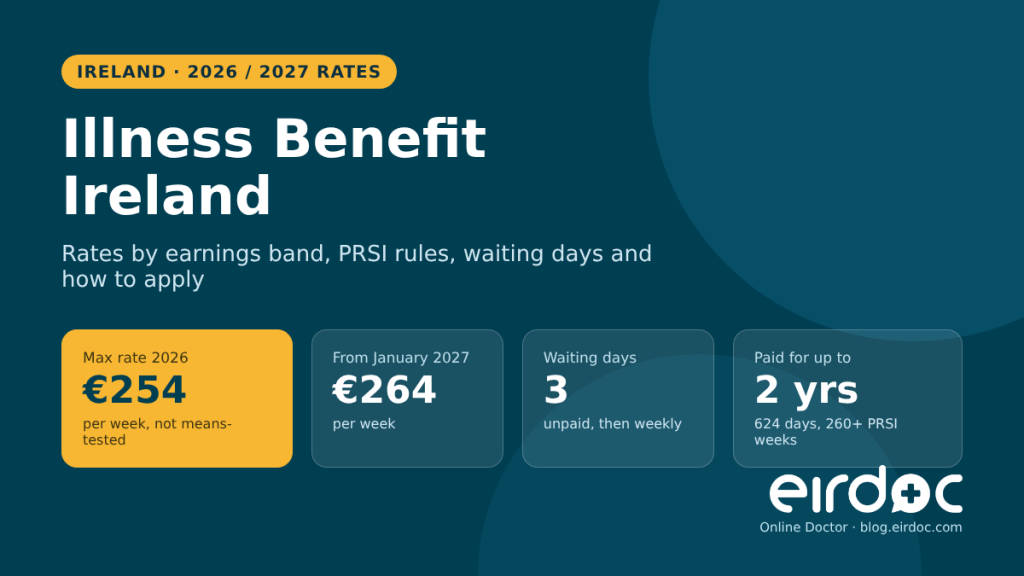
Illness Benefit is a weekly payment from the Department of Social Protection (DSP) for people under 66 who cannot work because of illness or injury and who have enough PRSI contributions. It is not means-tested. In 2026 the maximum personal rate is €254 a week, rising to €264 from January 2027. This guide covers the exact rates by earnings band, who qualifies, the three waiting days, what day it is paid, how long it lasts, and how to apply online with your medical certificate.
How much is Illness Benefit in 2026?
Illness Benefit is paid at a graduated rate based on your average weekly earnings in the relevant tax year (2024 for claims made in 2026). The four bands are:
| Average weekly earnings (2024) | Personal rate per week | Increase for qualified adult |
|---|---|---|
| €300 or more | €254.00 | €168.60 |
| €220 to €299.99 | €198.90 | €109.20 |
| €150 to €219.99 | €163.70 | €109.20 |
| Less than €150 | €114.00 | €109.20 |
Average weekly earnings are your gross earnings in the relevant tax year divided by the number of weeks you actually worked, so a few months of work at a good wage still puts you in the top band. A Child Support Payment of €58 a week (under 12) or €78 (12 and over) is added for each qualified child.
What changes from January 2027
Budget 2027, announced on 6 October 2026, raises the maximum personal rate by €10 to €264 a week and the qualified adult increase to €175.20. The Child Support Payment rises to €64 (under 12) and €84 (12 and over). The lower earnings bands rise proportionately.
Is Illness Benefit taxable?
Yes. The personal rate and the qualified adult increase are taxable, though tax is not taken off at source — Revenue reduces your tax credits instead. Child increases are not taxed. Employers who top up your pay while you are sick usually ask you to sign the Illness Benefit over to them.
Who qualifies for Illness Benefit?
You must meet all four conditions:
- Age: under 66.
- Unfit for work: certified by a doctor on a Certificate of Incapacity for Work.
- PRSI class: your contributions must be Class A, E, H or P. Class S (self-employed) does not count — see below.
- Enough contributions: at least 104 weeks of PRSI paid since you first started work, and either
- 39 weeks paid or credited in the relevant tax year (2024 for 2026 claims), of which at least 13 must be paid contributions; or
- 26 weeks paid in the relevant tax year and 26 weeks paid in the year before it (2023).
If you do not have 13 paid weeks in 2024, the DSP can look at 2025, 2023 or 2022 for them instead. You do not have to be in a job on the day you become ill — if you are unemployed but have the contributions (including credited contributions from Jobseeker’s), you can still claim.
Can self-employed people get Illness Benefit?
No. Class S PRSI, which self-employed people pay, does not cover Illness Benefit. If you are self-employed and cannot work because of illness your options are:
- Disability Allowance if the illness will last a year or more — it is means-tested but open to Class S contributors. See our guide to Disability Allowance in Ireland.
- Invalidity Pension if you are permanently incapable of work and have Class S contributions (Class S has counted for Invalidity Pension since 2017).
- Supplementary Welfare Allowance as a short-term safety net if you have no income.
- If you also had PAYE employment in 2024 with Class A contributions, you may qualify for Illness Benefit on those.
The 3 waiting days and Statutory Sick Pay
Illness Benefit is not paid for the first 3 days of your illness. These are “waiting days” and Sunday does not count as one. For most employees this gap is covered by Statutory Sick Pay (SSP) from the employer:
- SSP is 5 days a year at 70% of your normal pay, capped at €110 a day.
- You cannot get Illness Benefit for a day your employer paid SSP.
- If your illness lasts more than 5 days, Illness Benefit starts from day 6.
- If you have already used your 5 SSP days this year, Illness Benefit starts from day 4, after the 3 waiting days.
- An illness of 5 days or less does not need an Illness Benefit claim at all — SSP covers it.
To get SSP you need a medical certificate from day one, which is why getting a sick cert online the same day matters. Our guide to sick leave entitlements in Ireland explains SSP in full.
What day is Illness Benefit paid?
Illness Benefit is paid weekly, directly into your bank account. The DSP pays Illness Benefit on any day from Monday to Saturday — your payment day depends on when your claim was registered and the first day of your illness, so two people can be paid on different days. Once your first payment arrives it stays on the same weekday. The first payment may not cover a full week. You can see your payment schedule and history under “My payments” on MyWelfare.ie.
The first payment usually takes a week or two after the DSP receives both your claim and your medical certificate. Claims where the doctor sends the certificate electronically are processed fastest. If there is a delay and you have no income, apply for Supplementary Welfare Allowance at your local Intreo centre.
How long can you claim Illness Benefit?
| PRSI contributions paid | Maximum duration |
|---|---|
| 260 weeks or more | 624 payment days (about 2 years) |
| 104 to 259 weeks | 312 payment days (about 1 year) |
Payment days are counted six days a week (Sundays excluded). If your illness is likely to last beyond this, apply for Invalidity Pension or Disability Allowance well before your Illness Benefit runs out. If you can do some work, Partial Capacity Benefit lets you return part-time while keeping part of your payment — you must be on Illness Benefit for at least 6 months to apply.
You must send a new medical certificate for as long as you are claiming. Most GPs now send these electronically, and your doctor can certify you for several weeks at a time once your condition is stable.
How to apply for Illness Benefit
Apply within 6 weeks of becoming ill. Late claims can be backdated only if you have a good reason for the delay.
Online (fastest):
- Create or log in to a verified MyGovID account.
- Go to MyWelfare.ie → Illness Benefit → apply. You will need your PPS number, your employer’s details and your bank account (IBAN).
- Get a Certificate of Incapacity for Work from a doctor. If your GP completes it electronically it goes straight to the DSP and you get a copy; otherwise upload or post it.
- Submit the claim. Track it under “My applications”.
By post:
- Get the IB1 claim form from your GP, an Intreo centre or by request from the DSP.
- Have your doctor complete the Certificate of Incapacity for Work.
- Post both by Freepost to Social Welfare Services, P.O. Box 1650, Dublin 1.
Getting your medical certificate online
The certificate is the part most people get delayed on. The DSP accepts medical certificates from online doctors for the first 6 weeks of an illness, as long as the certificate is on headed paper showing the doctor’s name and Irish Medical Council registration number. So if you cannot get a GP appointment quickly, or you do not have a regular GP, an Eirdoc doctor can assess you by video and issue a certificate the same day, usually within a couple of hours, so your claim is not held up. Book an online consultation.
If your illness goes beyond 6 weeks, the DSP needs ongoing certificates from your own GP or treating hospital, so register with a GP in that time if you do not have one.
Illness Benefit vs Disability Allowance vs Invalidity Pension
| Illness Benefit | Disability Allowance | Invalidity Pension | |
|---|---|---|---|
| Based on | PRSI contributions | Means test | PRSI contributions (incl. Class S) |
| Illness length | Short or medium term | 1 year or more | Permanent / long-term |
| Max personal rate 2026 | €254 | €254 | €259.50 |
| Means tested? | No | Yes | No |
| Max duration | 1 or 2 years | No limit while eligible | No limit |
If you are unsure which applies, the DSP will usually tell you when your Illness Benefit is close to expiring. Our Disability Allowance guide covers the means test in detail.
Frequently asked questions
How much is Illness Benefit per week? Up to €254 a week in 2026 (€264 from January 2027) if your average weekly earnings in 2024 were €300 or more. Lower earners get €198.90, €163.70 or €114 depending on their band.
Is Illness Benefit means tested? No. It is based on your PRSI contributions and your average earnings in the relevant tax year, not on your savings or household income.
What day of the week is Illness Benefit paid into the bank? It is paid weekly, on any day from Monday to Saturday depending on when your claim was registered. The day then stays the same each week; check “My payments” on MyWelfare.ie.
How long does Illness Benefit take to be paid? Usually one to two weeks after the DSP has both your claim and your medical certificate. Electronic certificates from your doctor speed this up.
Can I get Illness Benefit if I am self-employed? No. Class S PRSI does not cover Illness Benefit. Self-employed people can apply for Disability Allowance (means-tested) or Invalidity Pension if the illness is long-term.
Can I get Illness Benefit if I am unemployed? Yes, if you have 104 paid contributions and enough paid or credited contributions in 2024. Credits from Jobseeker’s payments count towards the 39 weeks.
What was Enhanced Illness Benefit? A temporary COVID-19 scheme that paid €350 a week from day one to people told to self-isolate. It ended in 2022 and is no longer available.
Do I need a new medical certificate every week? You need a certificate covering every period you claim. Once your condition is stable your doctor can certify you for several weeks at a time, and most send it electronically to the DSP.
Will the DSP accept a certificate from an online doctor? Yes, for the first 6 weeks of your illness, provided it is on headed paper with the doctor’s name and Irish Medical Council registration number. After 6 weeks, certificates must come from your GP or treating hospital.
Need a medical certificate for your Illness Benefit claim?
Eirdoc’s Irish Medical Council registered doctors can assess you online and issue a medical certificate the same day — accepted by the DSP for the first 6 weeks of your illness — so your claim is not held up waiting for a GP appointment. Start your online consultation.
Sources
- Illness Benefit — Citizens Information
- Illness Benefit — gov.ie
- Budget 2027 — Department of Social Protection
- Statutory Sick Pay — Citizens Information
This article is for general information only and is not a substitute for individual advice from the Department of Social Protection or a medical professional.